
Checked against Palworld v1.0.3 · August 22, 2026
Client-Side vs Server-Side Palworld Mods
Learn how palworld client side mods differ from server-side and Both releases, with a multiplayer compatibility table, install checks and rollback steps.

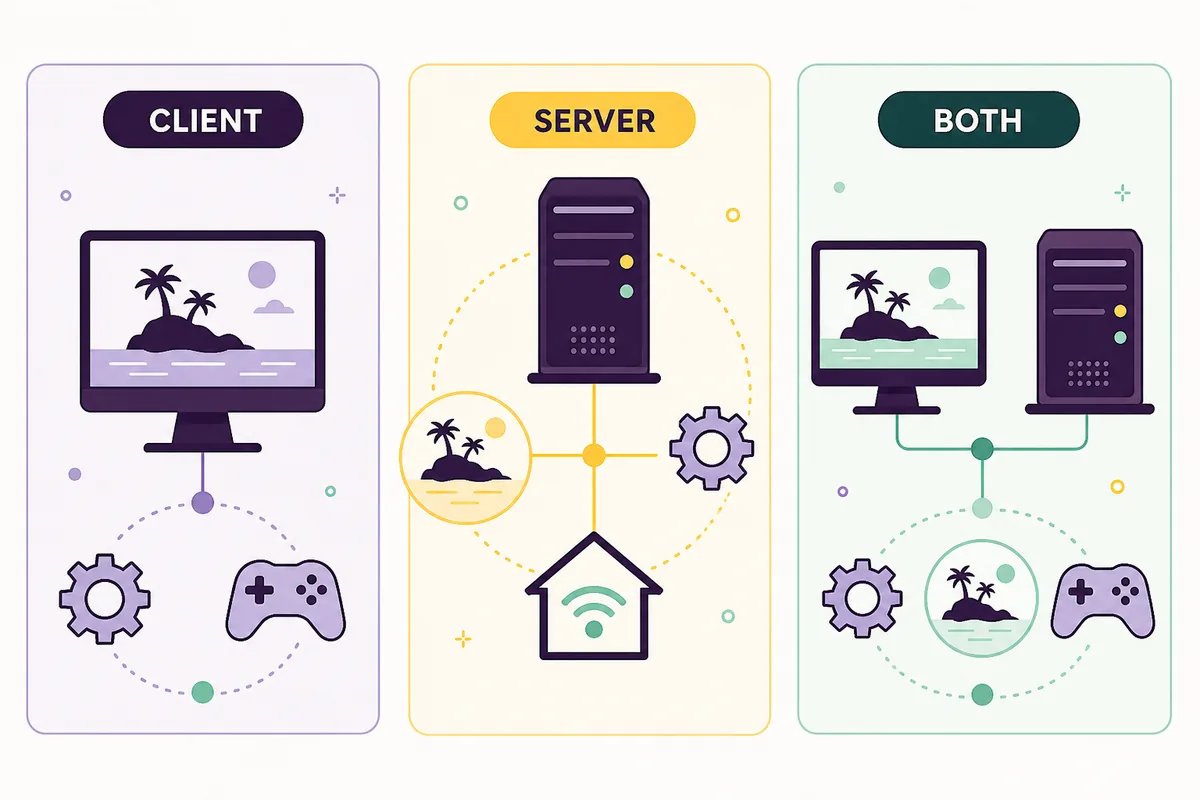
If you are looking for palworld client side mods, start with the release metadata rather than the download button. Client means the package runs for an individual player; Server means it is installed on the host; Both means the release may require matching files, versions or dependencies on both sides. The label is a starting point, not a promise that every server accepts the package.
Palworld client side mods: read the side label first
If you are looking for palworld client side mods, start with the release metadata rather than the download button. Client means the package runs for an individual player; Server means it is installed on the host; Both means the release may require matching files, versions or dependencies on both sides. The label is a starting point, not a promise that every server accepts the package.
Use a Client, Server or Both decision table
A cosmetic HUD change may be client-only, while recipes, capture rules, Pal data, inventory limits and shared world behavior are normally authoritative somewhere in the server session. Record the side, format, game version, loader and dependency list before installing. If the source page is vague, treat the release as unverified and test it on a backup world.
Why a client mod can fail in multiplayer
A client package can load correctly in solo play and still fail online because the host rejects it, the server expects matching content, or the package changes a value that the server controls. Do not infer compatibility from a clean menu launch. Join a test world, use the changed feature, save, restart and reconnect before inviting other players.
Match the format to the side
Steam Workshop, Pak, UE4SS Lua, LogicMods, PalSchema and standalone tools do not share one universal folder. A Client label does not tell you to copy files into a server directory, and a Server label does not prove that clients need nothing. Follow the publisher path exactly and keep the original archive beside the installation record.
Dedicated server checks
For a dedicated server, confirm that the host exposes the files, startup arguments and restart controls required by the release. The official server guidance is narrower than a general mod directory: server-built mods belong on the Windows dedicated-server edition, while a managed host or Linux setup may have different limits. If the host cannot provide the required loader, choose a server-native setting instead.
Run a reversible multiplayer test
Copy the save and configuration, record the working Palworld and loader versions, then change one layer at a time. Start with the server, connect one correctly configured client, test joining, travel, crafting, inventory and a save/restart cycle. If a failure returns, stop at the first changed package and compare its original source and issue tracker instead of stacking another DLL or archive.
Client, server and format checklist
| Label | What it tells you | What to verify |
|---|---|---|
| Client | Runs for an individual player | Whether it is allowed on the target server |
| Server | Runs on the host or dedicated server | Whether connecting clients need files |
| Both | May require matching setup | Exact version and dependencies on every side |
| UE4SS / Pak / LogicMods | Installation method | The publisher's exact path and loader version |
Understand the installation formats
Steam Workshop is the most direct route in Palworld 1.0: subscribing downloads a release and Mod Management controls whether it loads. A manual UE4SS package is different. It depends on a compatible loader and usually has a specific folder structure inside the game binaries. Pak and LogicMods packages are Unreal Engine content files, but they still do not share a universal destination. A PalSchema project or standalone server tool may operate outside the normal mod folders entirely.
Keep the downloaded archive until the setup works. Its folder tree helps identify what was added and makes removal more precise. If an archive contains several top-level folders, preserve that layout instead of flattening every file into one directory. Never rename a DLL, Pak file or script unless the publisher explicitly requires it.
Use a controlled update process
Game, loader and mod updates should be treated as three separate changes. Before updating, record the working Palworld version, loader build and package versions. Stop the game or dedicated server and make a copy of the save directory. Update Palworld first and confirm that an unmodded launch reaches the menu. Then update the loader and test again. Finally, add current mods one at a time.
For a multiplayer world, use a maintenance window. Prevent players from connecting while server files are in a mixed state. After the server starts, connect with one matching client and test joining, travel, crafting, inventory, Pal assignment and a full save/restart cycle. Only reopen the world after these checks pass.
Diagnose conflicts systematically
A startup crash points first to the loader, duplicate DLLs or an early-loading package. A crash while opening a world points more often to content, save or dependency conflicts. Infinite loading can involve a mismatched client and server set. Missing items after removal suggest that the save still references content supplied by the removed mod.
- Copy the affected save before experimenting.
- Disable all third-party packages and confirm the base game starts.
- Verify game files through Steam or the platform launcher.
- Restore the required loader only and test it without gameplay mods.
- Enable one package and its declared dependencies at a time.
- Stop when the problem returns, then check that source page and issue tracker.
Do not use a random replacement DLL or re-uploaded archive from an unknown page to solve a version mismatch. Return to the original publisher and compare its current requirements with your installation.
Verify the result after a change
A successful launch is only the first check. Load a test world, use the changed feature, save, exit completely and reload. In multiplayer, confirm that a player with the expected client setup can reconnect after the server restarts. Watch for missing recipes, invisible objects, repeated network corrections or new errors in the loader log.
If the mod changes structures, Pals or inventory data, test removal on a copy before relying on it long term. Some content cannot be removed cleanly after it is written into a save. A documented rollback plan is more useful than assuming the platform's file verification will restore world data; verification repairs game files, not a damaged save.
Safety and rollback
Third-party mods can break after a game update or conflict with another package. Keep an offline save backup, never overwrite the only working server copy, and retain a list of every file you add. This directory links to publishers but does not independently scan or guarantee their downloads.
A useful installation record includes the source URL, archive name, package version, loader version, install date and exact destination. Store that record beside the backup rather than inside the game directory. If removal is needed months later, it separates author-supplied files from normal Palworld files and reduces the chance of deleting unrelated data.
Official technical references
For the current Workshop and UE4SS process, use the community-maintained Palworld Modding Docs installation guide and Workshop troubleshooting guide. Server owners should also read the UE4SS server installation notes.
Palworld Client Side Mods: final verification
Use palworld client side mods as a complete workflow rather than a single file operation. Confirm the current source, Palworld version, loader requirement, install format and multiplayer side before changing the live game. Keep the original archive and a written list of added files beside an offline save backup. That evidence is what makes palworld client side mods reversible when a later update changes the loader or package requirements.
Finish by testing the exact result the guide describes. Launch a disposable world, perform the changed action, save, exit completely and reload. For multiplayer, restart the server and reconnect with one correctly configured client. If any step fails, stop and return to the last known-good state instead of stacking another fix on top. A reliable answer to palworld client side mods always includes a successful reload and a proven rollback path.
Keep the test record after success. It provides the exact working versions and paths to compare when Palworld, a loader or a dependency changes later. Review that record before every update.
Frequently asked questions
Are Palworld client side mods compatible with every server?
No. The server can reject a client-only package, or the release can require a matching server or dependency set. Check the source page and the host rules, then test with one backup world.
Do server-side Palworld mods require clients to install the same files?
Not always. A server-only change may need no client files, but a Both release or synchronized content package can require the same version and dependencies on every participating client.
How do I know whether a Palworld mod is client-side or server-side?
Look for the publisher label, install path, loader requirement and multiplayer notes. If those disagree or are missing, mark the release unverified and do not use it on the live save until a controlled test succeeds.
Can I use client-side mods on a dedicated server?
Only when the server and publisher instructions allow that setup. A client package is installed for the player, not automatically on the host; confirm whether the server accepts the package and whether every player must match.
What should I test after changing a side-specific mod?
Test a clean launch, join with one matching client, use the changed feature, save, exit, restart the server or game and reconnect. Keep the previous package set until the full cycle passes.